When you look at the nutrition section of the FYTA app, you’ll see two things: a calendar view with your fertilising curve and logged actions – and below that, a separate EC graph. But what does the EC value actually mean – and why don’t we simply show how much nitrogen, potassium or calcium is in the soil? This article explains how EC measurement works, what it can tell you, and how it feeds into the fertilising recommendation.
What is EC?
EC stands for electrical conductivity. The value indicates how well a liquid conducts electrical current. In the context of your plant, this means: the more salts dissolved in the soil water, the better it conducts electricity – and the higher the EC value.
Fertiliser is chemically made up of salts. When you fertilise, these salts dissolve in the substrate and increase the electrical conductivity of the soil water. The EC value is therefore a direct measure of the amount of nutrient salts currently available to your plant.
EC is measured in millisiemens per centimetre – abbreviated as mS/cm.
Why do we measure salts – and not individual nutrients?
That’s a fair question. Wouldn’t it be more useful to know exactly how much nitrogen, potassium or calcium is in the soil?
In theory, yes – but in practice, it isn’t possible with a single multi-sensor. Here’s why:
To reliably measure an individual nutrient, a sensor would need to be chemically or electrochemically calibrated to that specific substance. Calcium would require a calcium-selective sensor, nitrogen a different one – and every additional element would need its own dedicated sensor. This is possible in specialised laboratory equipment, but not in a compact soil sensor that simultaneously measures moisture, temperature, light and humidity.
Our sensor therefore measures salt content as a whole – that is, the total sum of dissolved ions in the substrate. This isn’t a compromise, but a deliberate choice: EC is a reliable proxy for overall nutrient supply. A high EC value indicates that plenty of nutrient salts are present. A low value indicates that the substrate has been depleted. This information is sufficient to tell you when your plant needs to be fertilised.
What EC cannot do: it doesn’t distinguish between different nutrients. Whether a high value is due to too much nitrogen or too much potassium cannot be determined from the EC value alone.
How does EC feed into the fertilising recommendation?
EC is an independent, measurable parameter – it has its own graph and can be read on its own. But it doesn’t determine the fertilising recommendation by itself.
Several factors feed into the calculation:
EC value – how many nutrient salts are currently present in the substrate
Growth Index – a daily score that evaluates how well moisture, temperature and light conditions were for your plant
Moisture absorption – how quickly the substrate dries out, which indicates the plant’s level of growth activity
Growth stage – whether the plant is in an active growth phase, a slow growth phase, or dormancy
Your input – information about your last fertilising session, repotting, and growth stage significantly improves the analysis
For ornamental plants (houseplants, decorative plants), the app automatically detects the growth stage based on sensor data – for example “Productive Growth,” “Slow Growth,” or “Dormant.” More or less fertiliser is recommended depending on the stage.
For productive plants – such as vegetables, herbs or cannabis – plants go through clearly defined growth phases like germination, vegetative stage or flowering stage. Since we can’t detect these phases automatically, your input matters here: by telling us which phase your plant is currently in, we can fine-tune the fertilising recommendation to its current needs.
What does the EC value tell you in practice?
EC value
What it means
Too low
The substrate is low in nutrients – your plant may soon need feeding
Optimal
Nutrient supply is good – no action needed
Too high
Too many salts in the substrate – this can damage roots
If the EC value is persistently in the red zone at the upper end, the app recommends flushing the substrate thoroughly with water or repotting the plant to reduce salt build-up. If it is persistently too low, it’s time to fertilise.
EC and moisture – inseparable
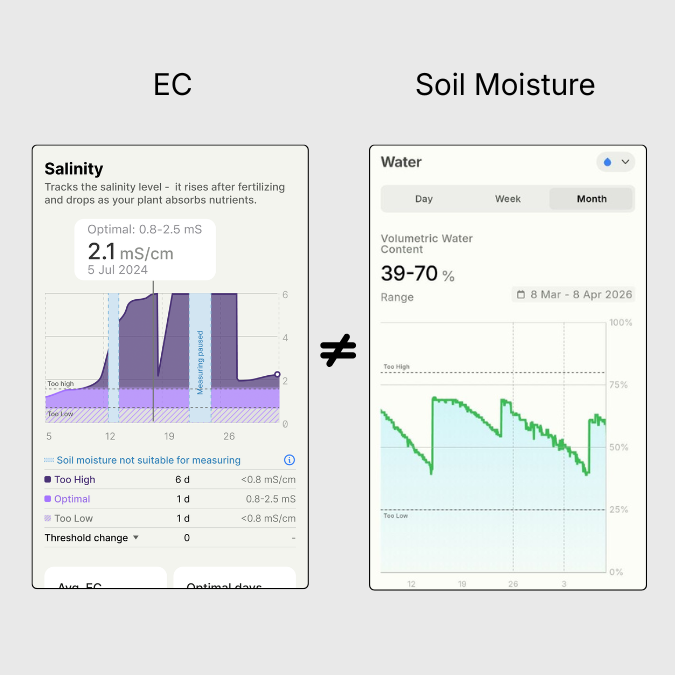
EC can only be measured reliably when there is sufficient water in the substrate. The reason: electrical conductivity is produced by dissolved ions in water. If the substrate is too dry, there is barely any water to act as a carrier medium – and therefore no reliable conductivity measurement. If the substrate is excessively waterlogged, readings can also be distorted.
EC measurements are therefore only meaningful within a specific moisture window.
Important: This particular moisture range does NOT correspond to your plant’s optimal moisture range.
The EC graph in the app – how to read it correctly
In the app, you’ll see the EC value displayed as its own graph below the calendar view. You’ll notice that the value isn’t always shown continuously – sometimes it appears in colour, sometimes it’s greyed out. There’s a clear reason for this:
Coloured = reliable. When the moisture content in the substrate is within the optimal range for EC measurement, the value is displayed in colour. You can rely on the reading at this point.
Greyed out = not reliable. When the moisture content is outside the measurement window – either too dry or too wet – the EC value is greyed out and marked as “Measuring paused.” This is not an error, but a deliberate signal: the sensor was unable to produce a reliable reading at that moment. As soon as the moisture level returns to the right range, the value will be displayed in colour again.
Why are there sometimes gaps in the graph? For exactly this reason: if the substrate has been too dry or too wet for an extended period, gaps will appear. This is normal and not a sign of a technical problem.
Conclusion
EC is an independent measurement with its own graph – and an important building block in the nutrient analysis. But it is only one of several factors. It is only in combination with the Growth Index, moisture absorption, growth stage and your own inputs that a fertilising recommendation emerges that truly fits your plant – more precise than any fixed schedule.



 FYTA
FYTA