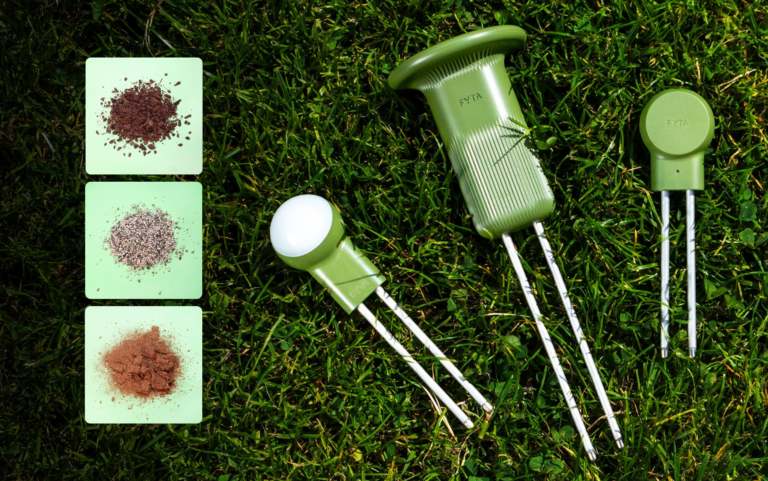
A behind-the-scenes look at how your FYTA sensor turns an electrical signal into a reliable moisture reading.
Why Your Sensor Doesn't Just "Know" It's 44%
Measuring soil moisture is not a trivial task. A moisture sensor doesn’t hand you a ready-made percentage — it produces a raw electrical signal, and how that signal should be interpreted depends heavily on the substrate type, its exact composition, and the length of the probes. Professional measurement devices deal with this by requiring users to run an extensive, individual calibration for their specific substrate before any reading can be interpreted at all.
FYTA deliberately abstracts this complexity away from you: instead of requiring you to calibrate the sensor yourself, we ship predefined calibrations for different substrate types and probe lengths.
Why This Abstraction Is Technically Demanding
This simplification on your end comes with real complexity behind the scenes: there are more than 20 substrate types in the app, along with several different probe lengths. On top of that, there’s a detail most people don’t know about: our sensors don’t have just one moisture sensor — they have several, each optimized for a different sensitivity range. Depending on whether the substrate is currently drier or wetter, a different sensor is the most reliable one for that range.
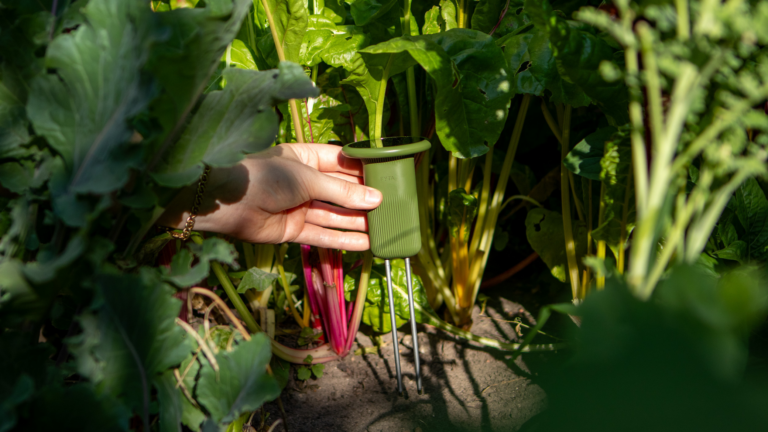
As a result, we don’t just need one curve per substrate type — we need one for each of the built-in moisture sensors, combined with the relevant probe length. On top of that, our outdoor garden sensor, the FYTA Terra, needs its own dedicated calibrations, since its probes sit further apart than on the Beam or Mini — a difference that directly affects the measured signal.
An Underestimated Challenge: Real Substrates Vary
Even within the same nominal substrate type, composition varies between manufacturers and batches, and it changes over time. A calibration curve that’s perfectly accurate on our lab reference substrate can therefore be slightly off in your individual pot. This natural variability is one of the core reasons why calibration remains a genuine challenge in soil moisture measurement, regardless of which sensor is used.
Our Approach: Logistic Calibration Curves
To address this challenge as effectively as possible, we use logistic calibration curves — one for each probe length and substrate type, matched to whichever of the built-in moisture sensors is best suited for that scenario.
Unlike a polynomial curve (a flexible mathematical function fitted through lab measurement points), a logistic curve is S-shaped: it naturally flattens out at both extremes — very dry and fully saturated. This closely matches how substrate actually behaves at these extremes. The curve is centered around what’s called an inflection point, which differs by substrate type — meaning some substrates show a more pronounced change in reading with even small amounts of added water than others.
Where Development Is Headed
Calibration is an area we continue to work on. Several developments are currently in progress:
Probe spacing. Since probes can spread apart slightly when pushed into firm substrate — which affects signal accuracy — we recommend not pushing the sensor directly into the soil, but instead digging a small hole and placing it there. We’re also exploring hardware solutions to keep probe spacing more consistent.
Outdoor soils. Standard potting substrate is fairly consistent from pot to pot, whereas natural garden soil tends to be much denser and varies significantly depending on your region. We’re working on better accounting for this in outdoor measurements.
Self-calibration. In the longer term, we want to give you the option to define the saturation point (or more precisely, the field capacity) of your own individual substrate yourself — giving you the benefit of substrate-specific calibration without the full complexity of a professional calibration workflow.
Self-learning calibration. Even the best static curve can never perfectly capture every substrate, installation, and season. That’s why we’re working on a self-learning model that learns the expected signal behavior for sensors in similar contexts (substrate, indoor/outdoor, climate), detects when an individual sensor systematically deviates, and adjusts its calibration accordingly — occasionally supported by a simple confirmation from you, such as after a thorough watering. What starts as a one-time lab-based calibration becomes a system that continuously improves with every sensor out in the field.




 FYTA
FYTA